Sand Tray Therapy Explained: A Window Into the Subconscious
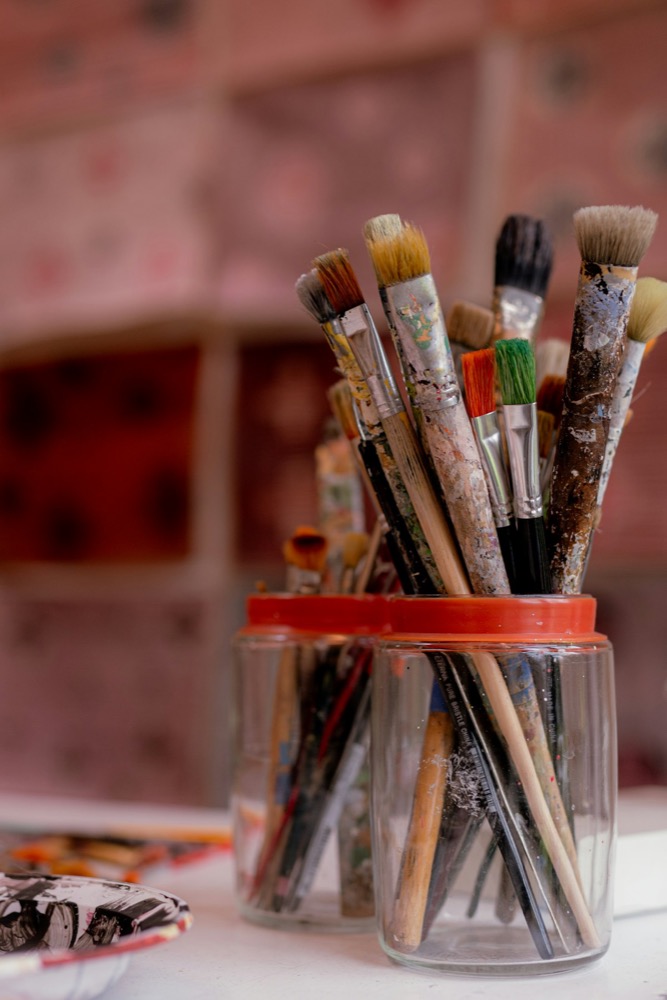
Walk into a room set up for sand tray therapy and you'll see shelves lined with hundreds of small figures — animals, people, houses, fences, bridges, trees, monsters, treasure chests, tiny cars. Nearby sits a shallow tray of sand. It doesn't look like traditional therapy, and that's exactly the point.
Sand tray is one of the expressive arts tools we use most often at New Path Counseling, with both children and adults. It gives clients a way to build, rather than explain, what's going on inside — and often, what gets built says more than words could.
What is sand tray therapy?
Sand tray therapy invites a client to select miniatures and arrange them in a tray of sand to create a scene. There's no "right" way to do it — a client might build something literal, like a memory of a specific event, or something entirely symbolic, like a landscape that captures how a relationship or an emotional state feels. The therapist doesn't direct the content; they observe, stay curious, and gently explore what emerges.
The technique has roots in Jungian psychology and play therapy, based on the idea that the unconscious mind often expresses itself more freely through symbol and image than through direct language — especially when a memory or feeling is too overwhelming, too early, or too unclear to describe in words.
Why sand and miniatures work when talking doesn't
There's something about the physical act of choosing an object, placing it, moving sand with your hands, that seems to lower the psychological defenses that often show up in a face-to-face conversation. Clients frequently report that they didn't fully understand why they chose a particular figure or placed it where they did until they stepped back and looked at the whole scene.
This matters clinically. A scene can safely represent chaos, danger, isolation, or conflict without the client having to say the words "I feel unsafe" or "I feel alone" out loud before they're ready. The tray becomes a container — a bounded, safe space where difficult material can be externalized and examined from a bit of distance.
What a sand tray session looks like
Every sand tray session unfolds a little differently, but the general process includes:
- Selecting figures — the client chooses whichever miniatures draw their attention, with no "correct" choices
- Building the scene — arranging the figures and sand, often quietly, while the therapist observes
- Reflecting together — the therapist asks open, non-leading questions about the scene: what's happening here, how do these two figures relate, is anything missing
- Processing — connecting what emerged in the tray to the client's real-life experience, at whatever pace feels safe
For children, sand tray often looks almost entirely like play — and that's appropriate. Play is a child's natural language, and meaningful therapeutic work happens even when it doesn't look like "therapy" from the outside.
Is sand tray therapy only for kids?
Not at all. While sand tray is a cornerstone of child and adolescent therapy because it matches how kids naturally communicate, we also use it regularly with teens and adults — particularly for trauma processing, grief, major life transitions, and situations where a client feels "I don't even know how to explain what's going on." Adults are sometimes surprised by how quickly a scene reveals a pattern they'd been circling around verbally for months.
How sand tray fits into a broader treatment plan
Sand tray is rarely used in isolation. At New Path Counseling, it's often integrated with trauma-focused work like EMDR, attachment-focused therapy, or standard talk therapy, depending on what a client needs. A single scene might be revisited over several sessions as it evolves, giving both client and therapist a visual record of how something is shifting over time.
If you're curious whether sand tray or other expressive arts approaches might be a good fit for you or your child, reach out for a free consultation. We offer sand tray therapy both in person in Springtown, TX and, where appropriate, adapted for virtual sessions.
Frequently Asked Questions
What is sand tray therapy?
Sand tray therapy is an expressive arts technique where a client uses miniature figures and a tray of sand to build a scene that represents their inner world, a memory, or a current struggle, allowing a therapist to explore material that may be difficult to access through talking alone.
Is sand tray therapy only for children?
No. While sand tray therapy is widely used with children because it matches their natural language of play, it is also highly effective for teens and adults, particularly for processing trauma, grief, and experiences that are hard to put into words.
What happens to the sand tray scene after a session?
The therapist typically photographs the finished scene for clinical notes and then returns the miniatures to their shelves before the next session. The client does not need to explain or interpret the scene themselves; the therapist observes and gently explores it with them.

Amber Lopez, MEd, LPC-S, RPT-S, CHST, BC-TMH
Amber is the founder of New Path Counseling and a Licensed Professional Counselor-Supervisor with over 10 years of experience in trauma-informed, attachment-focused therapy including EMDR. Read her full bio →